The circular journey of the wooden pallet
Billions of pallets move goods around the world every day, and 90% of them are wood. Plain and simple, they’re essential for modern supply chains, and a practical proof of concept for the circular economy. At the Sustainable Pallet Association, we believe sustainability must be measured across the entire lifecycle. By tracing the journey of a wooden pallet through its five core phases, it becomes clear why wood is not only essential for the logistics sector but also for the environment.
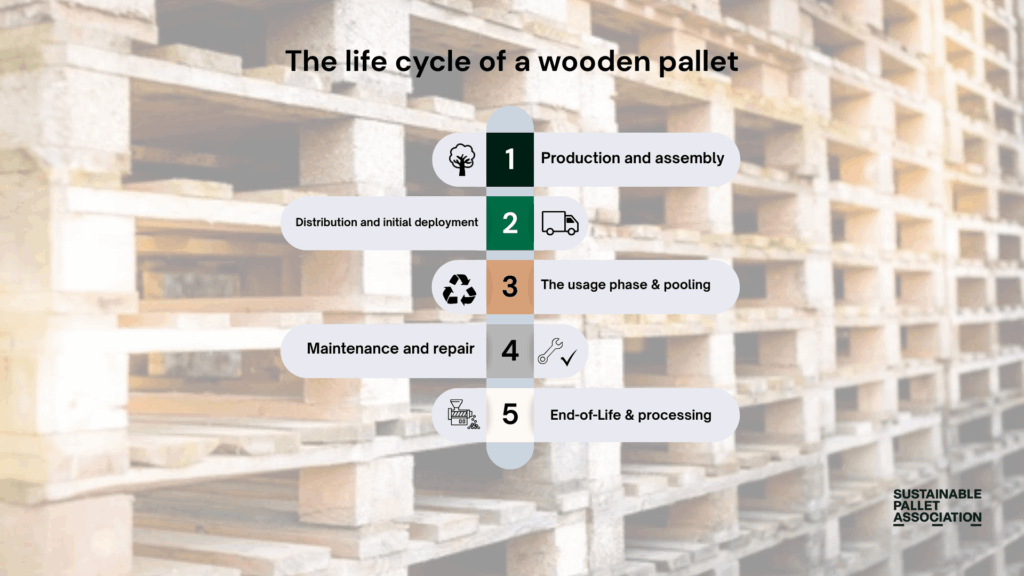
1. Resourcing and production: Carbon-negative beginnings
The lifecycle of a wooden pallet begins in nature. Unlike synthetic alternatives that require high-emission production processes, wood is naturally renewable and carbon-negative at the source.
- Sustainable forestry: The timber used for European pallet production is sourced from sustainably managed, FSC- and PEFC-certified forests. This responsible sourcing adds direct value to nature restoration and ensures the resilience of local forest ecosystems, where tree growth continuously exceeds harvesting. Trees naturally capture CO2 as they grow, and this carbon remains locked inside the wood.
- Manufacturing & treatment: Before assembly, the wood undergoes a mandatory heat treatment to prevent the spread of pests, ensuring it is hygienic and safe for international trade. Automated production lines then assemble the wood into standardized or custom pallets, requiring significantly less energy and emitting fewer greenhouse gases than the production of plastic alternatives.
2. Distribution and initial deployment
Once the new pallet is manufactured, it is acquired by a product manufacturer, distributor, or a specialized pooling organization. Goods are stacked, safely secured, and readied for dispatch. From this moment, the pallet begins its active journey, traveling via truck, train, or ship to transport goods to distribution centers and end receivers all over the world. Because of wood’s amazing temperature resistance and natural antibacterial properties, these pallets are highly trusted for transporting sensitive goods in the food and pharmaceutical industries.
3. The usage phase: The market structure
A wooden pallet has an impressive average operational lifespan of 7 years. During this time, it moves fluidly through the European economy. This market is very versatile and operates through three distinct, complementary systems:
- Market-driven open system (~65%): The vast majority of pallets are sold and traded through a highly resilient, decentralized secondary market.
- Closed-Loop / pooling (~20%): A rental company retains ownership of the pallets, leasing them for specific shipments and managing their entire lifecycle and maintenance.
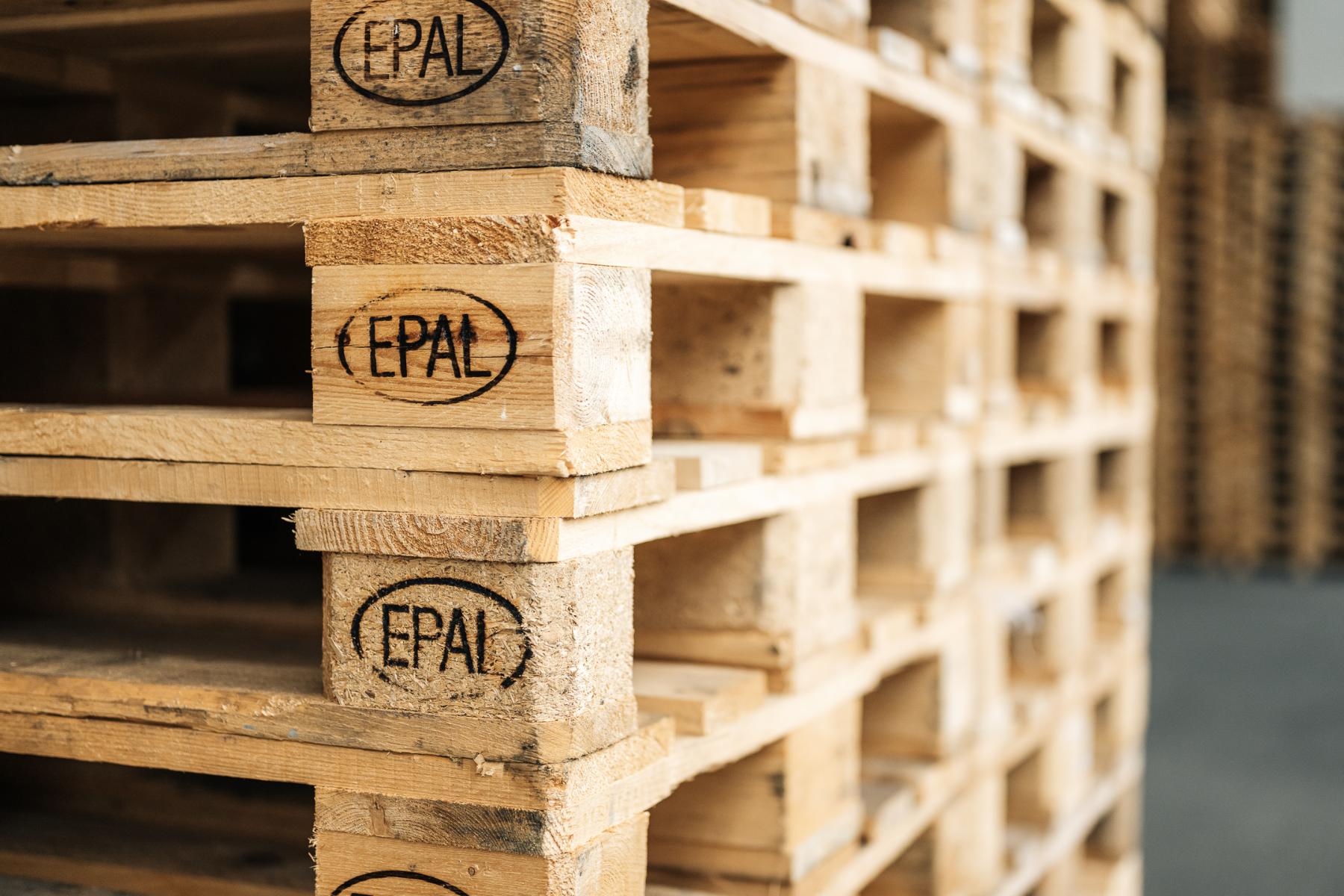
- Standardized open-pool (~15%): In systems like the EPAL model, standardized pallets are swapped on a 1-to-1 basis. Companies deliver goods on one pallet and instantly receive an empty, equivalent one in return, transferring ownership with each exchange.
4. Maintenance, repair, and reuse
Given the external factors that happen in logistics, it is possible that pallets will occasionally experience damage over their 7-year lifespan. However, unlike plastic pallets, which generally cannot be repaired and must be melted down when cracked, a damaged wooden pallet is easily fixed. Broken deck boards or stringers are simply replaced with new or reclaimed wood, extending the pallet’s functional life for dozens of additional rotations. This repairability drives an unmatched 95% reuse and repair rate in the sector. Furthermore, this phase supports a massive, localized ecosystem of thousands of Small and Medium-sized Enterprises (SMEs) that are dedicated to recovering, sorting, and repairing broken pallets to safely bring them back onto the market.
5. End-of-Life and processing: true circularity
When a wooden pallet finally reaches the point where it can no longer be repaired to bear heavy loads, it does not become useless waste. It continues to serve the circular economy in its final phase:
- Component reclamation: Viable boards and nails are extracted to be used in the repair of other pallets.
- Downcycling: The remaining wood is shredded and repurposed for the particleboard industry, giving the material a second life in construction or furniture.
- Energy recovery: Any non-recyclable wood chips are utilized as biomass fuel. In alignment with zero-waste principles, this process returns energy to the system and actively displaces the need to burn fossil fuels.
From the forest to the end of its life, the wooden pallet is circular by design. It bridges the gap between economic necessity and environmental responsibility, remaining the most cost-effective and sustainable load carrier available.